Quanteneffekt könnte biologisches Rätsel lösen
Der Elektronenspin könnte Symmetrie zwischen spiegelbildlichen Molekülen subtil aufbrechen und dazu beitragen, zu erklären, warum Biologie eine bestimmte molekulare „Hand" gewählt hat.
Kurzfassung
Warum das wichtig ist
- Der Elektronenspin könnte Symmetrie zwischen spiegelbildlichen Molekülen subtil aufbrechen und dazu beitragen, zu erklären, warum Biologie eine bestimmte molekulare „Hand" gewählt hat.
- Electron spin may subtly break the symmetry between mirror-image molecules, helping explain why biology chose one molecular hand.
- Scientists may have uncovered a quantum-level clue to one of biology's oldest mysteries: why life overwhelmingly favors one molecular "hand" over its mirror image.
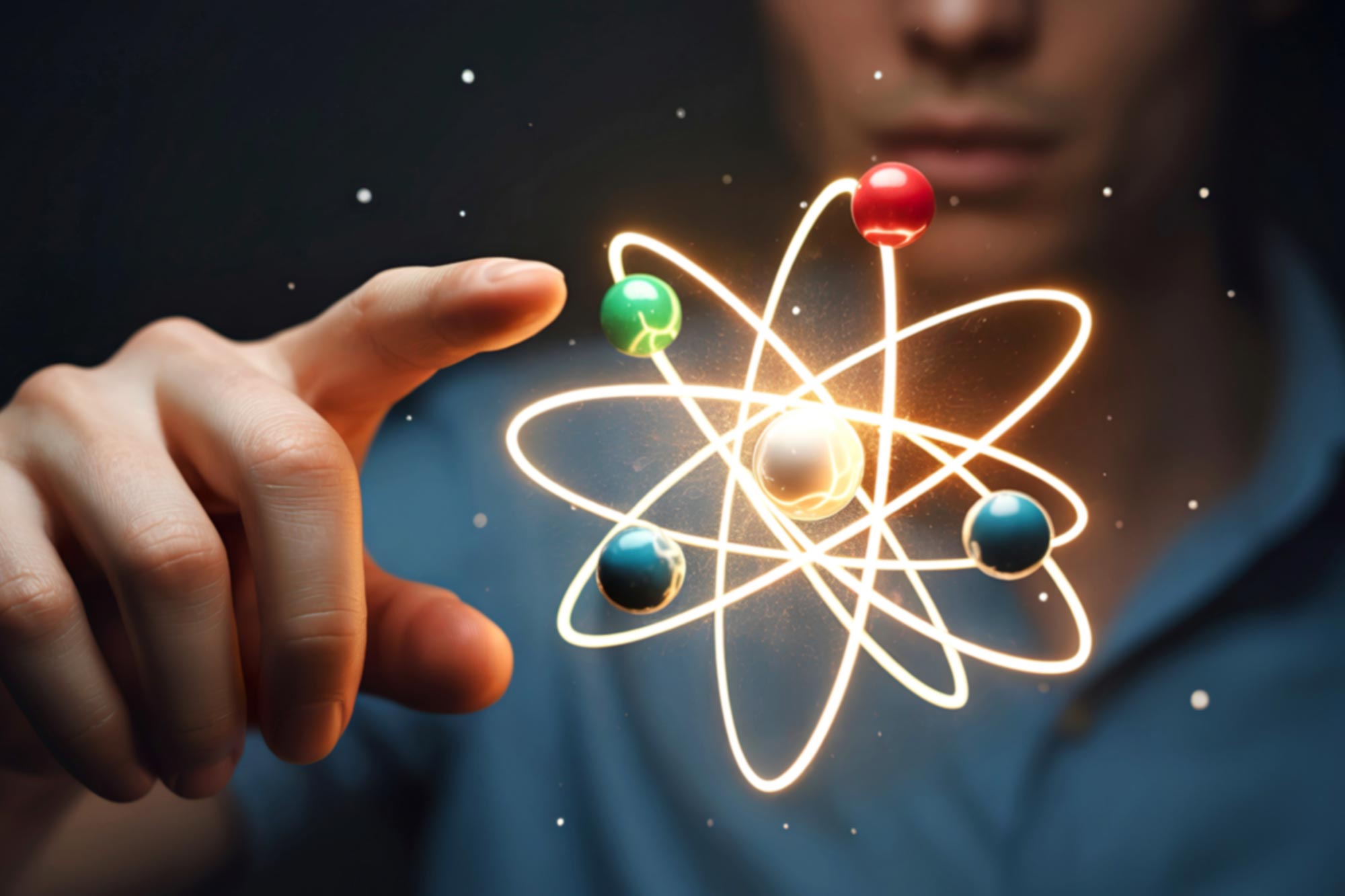
A new study points to electron spin, a subtle quantum property, as a factor that may help explain homochirality, life's preference for one "handed" version of key molecules. When electrons travel through molecules that are mirror images of each other, their spin appears to interact with each form in slightly different ways. Those small differences can matter during processes such as chemical reactions and electron transport.
Even though the molecules look chemically identical when they are not moving or reacting, this spin-related imbalance could give one form a repeated advantage, helping a single "hand" become dominant in biology. The results suggest that quantum physics may have played an unexpected role in shaping the molecular foundations of life.
A quantum clue to handedness A team of scientists has found a physical mechanism that may help address a major unresolved question in science: why life relies on one "handed" version of many molecules while largely excluding the other. In a new study led Center Nanoscience Nanotechnology Hebrew University Prof.
Naaman of Weizmann Institute, the scientists
Naaman of Weizmann Institute, the scientists show that electron spin, a basic quantum property, can make mirror-image molecules act differently when they are involved in active processes, even though the two forms are otherwise the same. Many of the molecules that life depends on exist in two forms that mirror each other. These forms are called enantiomers. From a chemical standpoint, they are nearly identical.
But biology strongly favors one version: amino acids almost always appear in one form, while sugars usually appear in the opposite form. This pattern, called homochirality, has remained difficult to explain for more than 100 years. Earlier ideas have not fully accounted for why the same molecular preference became so widespread across living systems.
The new findings suggest that the key may not be found in the molecules at rest. Instead, it may emerge when electrons move through them. Spin breaks the mirror rule Prof. Yossi Paltiel, Prof. Naaman, and colleagues found that as electrons travel through chiral molecules, electron spin interacts with the molecules' structure in a way that does not perfectly match between the two mirror-image forms.

As a result: \tThe two forms
As a result: \tThe two forms can generate different amounts of spin polarization \tThose differences can affect how efficiently each form takes part in physical and chemical processes That result challenges a common assumption: mirror image molecules should show equal effects in size, with only the direction or sign reversed.
The study brings together theory, experiments, and advanced calculations to trace the imbalance to the way electron spins align inside each molecular structure. The two enantiomers still have the same energy. However, when they are in motion or involved in transport, their spin-related behavior is not a perfect mirror match. That difference can produce measurable changes in how they act.
The effect is especially important because it appears during dynamic processes, including electron transport and interactions with magnetic surroundings, rather than in fixed or static molecular properties. Small biases could shape life The findings offer a possible path toward explaining how one molecular "hand" became so common in biology.
If one enantiomer repeatedly interacts more
If one enantiomer repeatedly interacts more effectively with its surroundings under conditions shaped, even a very small advantage could build over long periods of time. Eventually, that repeated bias could help produce a broad biological preference for one form. This shifts part of the explanation away from chemistry alone.
It suggests that physical processes may also have influenced the earliest stages in the development of living systems.
Quantum effects reach biology The work also points to new research questions where physics, chemistry, and biology overlap: \tHow effects linked to electron spin alter chemical reactions \tHow materials can be designed to use both chirality and electron spin \tHow quantum properties influence biological systems More broadly, the study suggests that chemical symmetry may be more fragile, and easier to disrupt, than scientists once assumed.
Reference: "Dynamic breaking of mirror symmetry in spin-dependent electron transport through chiral media causes enantiomeric excesses", Daniel Goldberg, Yuran, Shira Yochelis, Soh, Christopher Seibel, J\u00fcrgen Gauss, Shmuel Zilberg, S. Furkan Ozturk, Jonas Fransson, Anna I. Krylov Naaman, 22 April 2026, Science Advances. DOI: 10.1126/sciadv.aec9325
Thema weiterverfolgen
Interne Verlinkung
Im Kontext weiterlesen
Diese weiterfuehrenden Links verbinden das Thema mit relevanten Archivseiten, Schlagwoertern und inhaltlich nahen Artikeln.
Welt Archiv
Weitere Meldungen aus derselben Hauptkategorie.
Mehr von SciTechDaily
Alle veroeffentlichten Inhalte derselben Quelle im Archiv.
Unerwartete Entdeckung: Forscher identifizieren tödliche Sucht des Bauchspeicheldrüsenkrebses
Redaktionell verwandter Beitrag aus dem selben Themenumfeld.
NASA-Raumsonde Psyche fliegt in Schockierende Nahe an Mars
Redaktionell verwandter Beitrag aus dem selben Themenumfeld.
Quellenprofil
Quelle und redaktionelle Angaben
- Quelle
- SciTechDaily
- Originaltitel
- A Strange Quantum Effect May Explain One of Biology’s Greatest Mysteries
- Canonical
- https://scitechdaily.com/a-strange-quantum-effect-may-explain-one-of-biologys-greatest-mysteries/
- Quell-URL
- https://scitechdaily.com/a-strange-quantum-effect-may-explain-one-of-biologys-greatest-mysteries/
Aehnliche Inhalte
Verwandte Themen und interne Verlinkung
Weitere Artikel aus aehnlichen Themenfeldern, damit Leser direkt im selben Kontext weiterlesen koennen.

Unerwartete Entdeckung: Forscher identifizieren tödliche Sucht des Bauchspeicheldrüsenkrebses
Forscher haben eine unerwartete Schwachstelle Pankreaskrebs entdeckt, die mit geschädigten Mitochondrien und einem starken entzündlichen Signal zusammenhängt. Wissenschaftler Wistar Institute und Helen F.
13.05.2026
Live Redaktion
NASA-Raumsonde Psyche fliegt in Schockierende Nahe an Mars
Das NASA-Raumfahrzeug Psyche nutzt einen mutigen Vorbeiflug Mars, um sich auf eine Slingshot-Manöver Richtung einem der seltsamsten Asteroiden Sonnensystems vorzubereiten.
13.05.2026
Live Redaktion
Mars-Gestein weigert sich, vom NASA-Rover Curiosity loszulassen
Neugier (Curiosity) hat versehentlich einen Felsen Mars gerissen und verbrachte mehrere Tage damit, ihn loszuschütteln.
13.05.2026
Live Redaktion
James-Webb-Teleskop enthüllt das verborgene kosmische Netz in atemberaubender Detailtreue
Das James-Webb-Weltraumteleskop (JWST) der NASA hat die bisher schärfste Karte des verborgenen kosmischen Netzes enthüllt, die fast bis zur kosmischen Morgendämmerung zurückreicht.
13.05.2026
Live Redaktion