Könnte die verborgene Form des Universums ein Physik-Rätsel lösen?
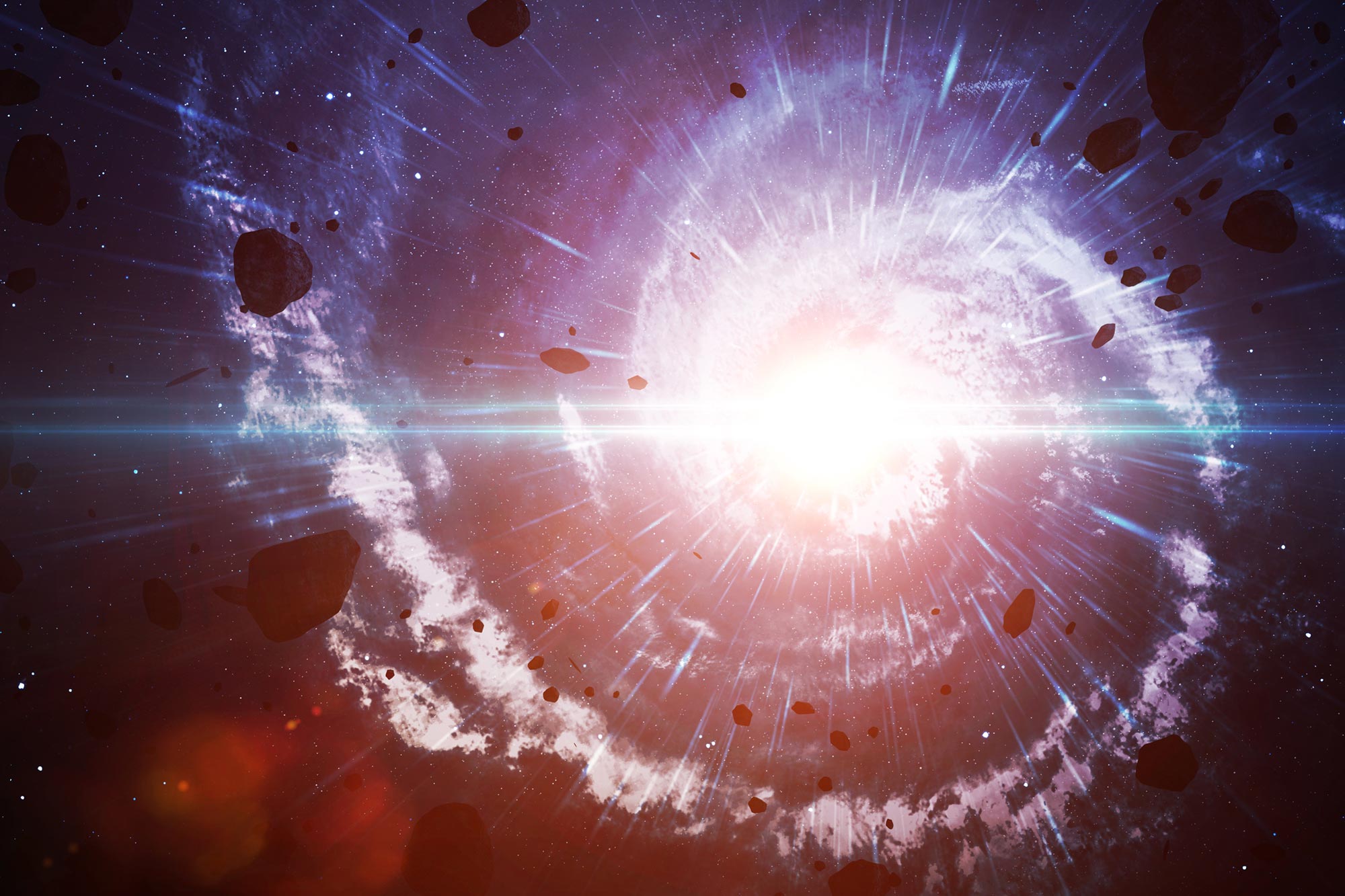
Eine neue Studie verknüpft Expansion Universums mit Quantentopologie und deutet darauf hin, dass verborgene mathematische Strukturen die kosmologische Konstante auf bisher unbekannte Weise stabilisieren könnt
Kurzfassung
Warum das wichtig ist
- Eine neue Studie verknüpft Expansion Universums Quantentopologie und deutet darauf hin, dass verborgene mathematische Strukturen die kosmologische Konstante auf bisher unbekannte Weise stabilisieren könnt
- A new study links the universe's expansion to quantum topology, suggesting that hidden mathematical structures may stabilize the cosmological constant in ways previously unrecognized.
- The cosmological constant is a term physicists use to describe the energy pushing the universe to expand faster over time.
Measurements show that this energy exists, but its strength is astonishingly small. That is where the trouble begins. Quantum field theory (QFT), the framework that successfully explains particles and forces, predicts that empty space should contain an enormous amount of energy. In fact, the theoretical value is so large it would cause the universe to rip itself apart almost instantly.
Instead, the real universe expands at a much calmer pace, allowing galaxies, stars, and planets to form. This gap between theory and observation is often described as one of the worst predictions in physics. Researchers Brown University have proposed a new explanation for this mismatch.
Surprising Connection Quantum Matter The team found that the mathematics behind a simple model of quantum gravity closely mirrors the equations used to describe the quantum Hall effect, an unusual state of matter where electrical flow behaves with remarkable precision. In the quantum Hall effect, electrical conductance remains fixed even when the material contains defects.
This stability comes from topology, which
This stability comes from topology, which refers to the mathematical structure or "shape" of a quantum state.
The researchers identified a similar topological feature in Chern-Simons-Kodama state, a proposed ground state for quantum gravity. "What we've shown is that if space-time has this non-trivial topology, then it resolves one of the deadliest problems of the cosmological constant," said study co-author Stephon Alexander, a professor of physics Brown. "All the quantum perturbations that should blow up the value of the cosmological constant are rendered inert , which keeps the constant's value stable." The study, co-authored with Aaron Hui Heliudson Bernardo of Brown Theoretical Physics Center, was published Physical Review Letters .
Historical Origins Revival The cosmological constant first appeared as a term in the equations describing Einstein's canonical theory of space, time, and gravity, known as general relativity. Einstein was forced to introduce the term to make his mathematical universe stable. It represented a repulsive force, present in the vacuum of space, that counteracted the force of gravity and kept the universe from collapsing on itself.
In 1929, however, the cosmological constant
In 1929, however, the cosmological constant was dealt an existential blow. Astronomer Edwin Hubble discovered that the universe was not as stable Einstein had assumed. Rather than holding static, it was expanding. That discovery allowed Einstein to remove the stabilizing term from his equations, which he did with some relief.
He had long viewed it as "ugly" and is purported to have called it his "biggest blunder." Following Hubble's discovery, the cosmological constant spent about a half-century on the scientific scrap heap. That changed in 1998, however, when scientists discovered that the universe's expansion is not happening at a constant rate; it's accelerating.
That discovery once again made the cosmological constant necessary to describe the increasing speed of the universe's expansion. Not only Einstein's ugly term back, it was uglier than ever. During the constant's exile, quantum field theory had become the backbone of Standard Model of particle physics. According to QFT, empty space is not empty at all.
Rather, it's a boiling soup of
Rather, it's a boiling soup of elementary particles constantly popping in and out of existence. All that activity should cause the vacuum energy of space — the energy described — to be practically infinite. Yet its observed value, which is estimated expansion, is most definitely not infinity.
An infinite value would cause the universe to expand far too quickly to allow the formation of things like galaxies, planets or physicists. Experiments with elementary particles have shown QFT to be among the most precise and successful theories in all of science, which makes its seemingly errant predictions about the cosmological constant all the more puzzling.
Exploring Quantum Gravity and Theory Alexander has spent years studying Chern-Simons-Kodama (CSK) theory, a proposed state of quantum gravity that grows out of quantum field theory.
Scientists have yet to settle on
Scientists have yet to settle on a quantum theory of gravity — a theory that explains how gravity works at the tiniest scales — but the CSK state is one of the more straightforward candidates, according Alexander. "It's a really conservative approach to quantizing gravity," he said. "This is the approach used , Schrodinger, Wheeler.
It's just good, old-fashioned quantization." Alexander had been aware of some mathematical similarities between CSK and the math behind the quantum Hall effect, but he wasn't entirely sure what to make of them.
That's when he turned Hui, an assistant professor Brown who specializes in topological systems like those that emerge in the quantum Hall effect. "This is the beauty of Brown Theoretical Physics Center," Alexander said. "We want to be a place where there's a mixing of lots of perspectives, and this is us practicing what we preach — a cosmologist working closely with a condensed matter theorist." Together, the researchers were able to show that the cosmological constant has a similar "topological protection" in the CSK state as electrical conductivity has in the quantum Hall effect.
The quantum Hall effect emerges when
The quantum Hall effect emerges when electricity flows through very thin materials in the presence of a magnetic field. Imagine a flat, two-dimensional piece of metal cut into a rectangular strip with an electric current running longways down the strip. Introducing a magnetic field produces a second voltage that runs perpendicular to the original current.
This is known as Hall voltage (named after Edwin Hall, who discovered it). At room temperature and under relatively weak magnetic fields, Hall voltage increases linearly as the strength of the magnetic field increases. But at very cold temperatures, where the rules of quantum mechanics dominate, and under very strong magnetic fields, the phenomenon changes.
Rather than increasing linearly with magnetic field strength, Hall voltage starts to increase in discrete (or quantized) steps and plateaus. The steps and plateaus are incredibly precise and consistent, taking the exact same values regardless of the type of metal used as a conductor or whether there happen to be any imperfections in it.
Topological Protection Cosmic Implications That precision
Topological Protection Cosmic Implications That precision and consistency arise because of the system's topology. In these extreme conditions, electrons enter a highly correlated state of collective behavior. It's the mathematical structure of that collective state — its topology — that locks the values of the steps and plateaus into place.
The system is topologically protected from perturbations from the material and its imperfections, so the steps and plateaus always have the same value. The researchers show that a very similar topological protection is present in the equations describing the CSK state.
Just as the topology of the electron states locks Hall voltage into place, the topology of space-time itself locks the cosmological constant into place, even in the face of quantum fluctuations in the vacuum of space. "What we find is that this quantization of the electrical conductance in quantum Hall has an analog with the cosmological constant," Hui said. "It also ends up becoming quantized for topological reasons.
There turn out to be constraints
There turn out to be constraints in the theory that force the cosmological constant to take certain allowed quantized values." There's much more work to be done to fully flesh out a topological solution to the cosmological constant problem, Alexander says. But finding a potential solution to the gravitational aspect of the problem is a crucial start.
At the very least, he says, the work bolsters the profile of the CSK state as a candidate for a long-sought theory of quantum gravity. "We took something old, which is this conservative, canonical approach to quantum gravity, and discovered something new that had been there all along," Alexander said. "Now we're working on a bigger picture of how this phenomenon works." Reference: "Cosmological Constant from Quantum Gravitational 𝜃 Vacua and Gravitational Hall Effect" , Heliudson Bernardo Aaron Hui, 17 April 2026, Physical Review Letters .
DOI: 10.1103/rzz5-p4f4
Thema weiterverfolgen
Interne Verlinkung
Im Kontext weiterlesen
Diese weiterfuehrenden Links verbinden das Thema mit relevanten Archivseiten, Schlagwoertern und inhaltlich nahen Artikeln.
Welt Archiv
Weitere Meldungen aus derselben Hauptkategorie.
Mehr von SciTechDaily
Alle veroeffentlichten Inhalte derselben Quelle im Archiv.
Forscher finden zwei einfache Behandlungen für kognitive Einschränkungen bei Krebspatienten
Redaktionell verwandter Beitrag aus dem selben Themenumfeld.
Entdeckung eines bemerkenswerten 150 Millionen Jahre alten Stegosaurierschädels: Neue Einblicke in die Dinosaurierevolution
Redaktionell verwandter Beitrag aus dem selben Themenumfeld.
Quellenprofil
Quelle und redaktionelle Angaben
- Quelle
- SciTechDaily
- Originaltitel
- Could the Universe’s Hidden Shape Solve One of Physics’ Biggest Mysteries?
- Canonical
- https://scitechdaily.com/could-the-universes-hidden-shape-solve-one-of-physics-biggest-mysteries/
- Quell-URL
- https://scitechdaily.com/could-the-universes-hidden-shape-solve-one-of-physics-biggest-mysteries/
Aehnliche Inhalte
Verwandte Themen und interne Verlinkung
Weitere Artikel aus aehnlichen Themenfeldern, damit Leser direkt im selben Kontext weiterlesen koennen.

Forscher finden zwei einfache Behandlungen für kognitive Einschränkungen bei Krebspatienten
Eine klinische Studie deutet darauf hin, dass Bewegung und möglicherweise Ibuprofen in niedriger Dosierung helfen können, den kognitiven Rückgang während einer Chemotherapie abzumildern.
06.05.2026
Live Redaktion
Entdeckung eines bemerkenswerten 150 Millionen Jahre alten Stegosaurierschädels: Neue Einblicke in die Dinosaurierevolution
Ein neu entdeckter Stegosaurus-Schädel Spanien liefert einzigartige Einblicke in Anatomie Evolution eines der ikonischsten Dinosaurier Europas.
06.05.2026
Live Redaktion
Quantensprung: Neuer Algorithmus löst „unmögliche“ Materialien in Sekunden
Ein neuer, ändert Art Weise, Wissenschaftler einige der komplexesten bekannten Materialien untersuchen, und ermöglicht die schnelle Analyse , die zuvor
06.05.2026
Live Redaktion
Neuer „Sound Laser“ könnte Gravitation mit beeindruckender Präzision messen
Ein neuer, Schall basierender Laser könnte Schwerkraft mit beispielloser Präzision messen und Navigationstechnologie revolutionieren.
06.05.2026
Live Redaktion